
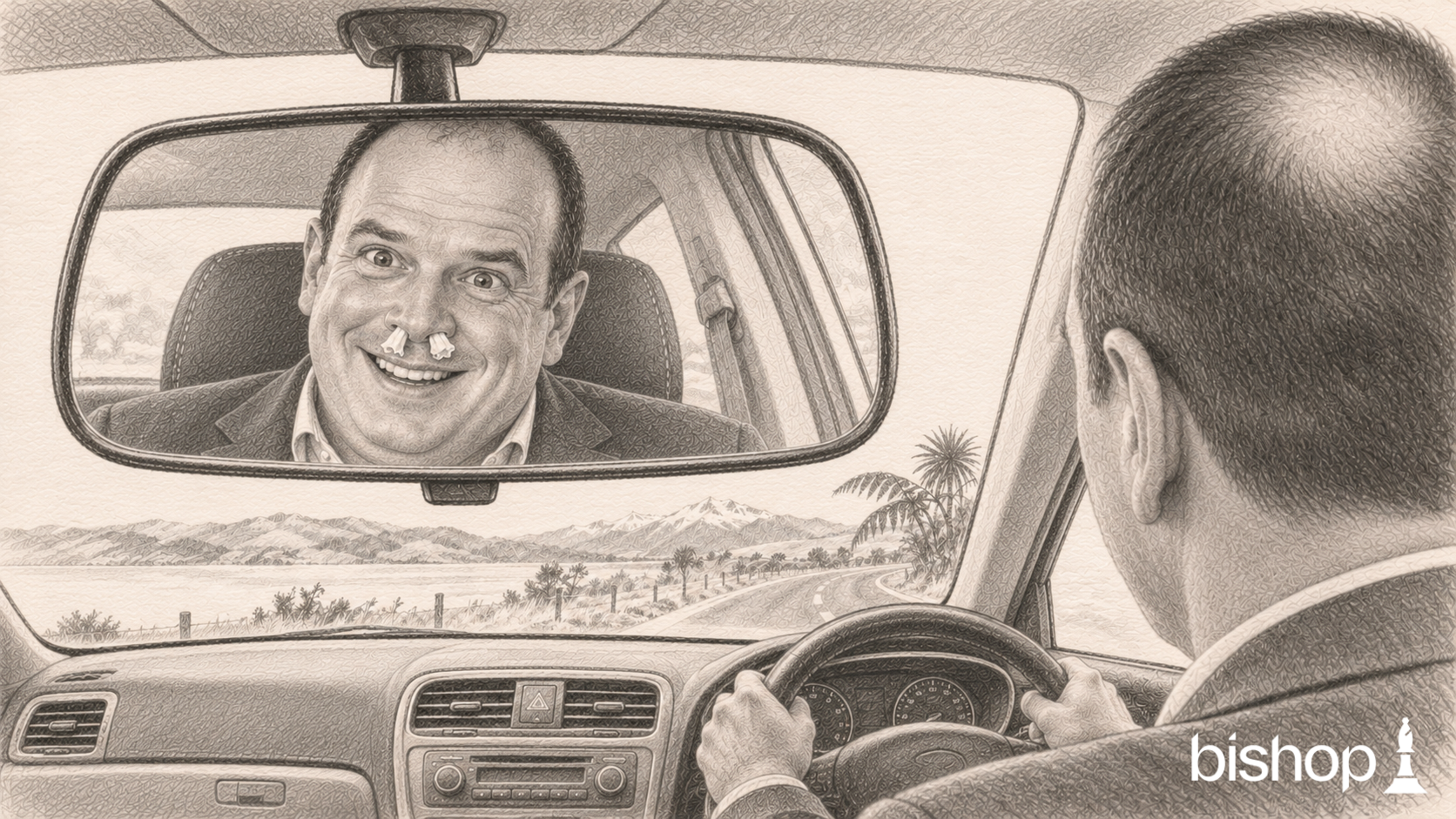
Some thoughts on Nigel Latta, confidence, kindness, being ourselves and the double whammy of boogers and baldness…
I recently lost a piece of business.
Now, this isn’t something I particularly enjoy admitting. I’m an executive search consultant, and after a fair few years in the business, I like to think I’m reasonably good at what I do. We’ve built a great team at Bishop, developed some excellent networks and, generally speaking, have a pretty good track record when we’re invited to pitch for new work.
So, when we weren’t successful with a recent proposal following what I’d thought was a pretty positive client briefing meeting, I was naturally a little disappointed. There were probably perfectly sensible commercial reasons why the client chose another provider. Perhaps their proposal was stronger. Perhaps they offered something we didn’t. Perhaps the client simply preferred their approach.
Or perhaps it was the booger!
You see, having completed the meeting and returned to my car, I happened to catch sight of myself in the rear-view mirror. There, proudly attached to the edge of my nostril, was a rather conspicuous example of something that really should have remained inside my nose.
Klingons on the starboard bow!
I have absolutely no idea how long it had been there. Had I conducted an otherwise professional, intelligent and engaging conversation while sporting an unwelcome nasal passenger? Had my prospective client spent the entire meeting desperately trying not to look at it?
And, most importantly, was this why we didn’t get the work? Probably not. But it did get me thinking…
How much of our success is about how we show up?
We’re constantly making judgements about other people. We notice how they dress, how they speak, how confidently they carry themselves and whether we find them engaging or likeable.
In my profession, understanding people is fundamental to what we do. Yet even with decades of experience, I know that first impressions can be surprisingly powerful, and occasionally misleading.
Confidence can look like competence. Charm can look like credibility. And someone who is naturally reserved or a little awkward can easily be underestimated. The reality is that being likeable and being capable are not necessarily the same thing, which is a sobering thought for someone whose job is to tell the difference.
I also suspect that how comfortable we are in our own skin has a significant influence on how we present ourselves to the world.
Which brings me to my rapidly disappearing hair.
I’m a man in my fifties who has been gradually cultivating an increasingly impressive example of male pattern baldness. Both my brothers have already surrendered to the inevitable and shaved their heads. Very sensible. I, however, continue to cling to the increasingly optimistic notion that there’s still enough happening up there to justify regular appointments with my hairdresser.
At some point, I suspect, the balance will shift. Will the shaved version of Rob look more confident, capable and credible? Will people take me as seriously? Will I still recognise myself?
Or, perhaps more importantly, will anybody else actually care? I suspect the answer to that last question is considerably less than I imagine!
Because the booger and the hair are really the same story. Both are about the assumptions I make about how other people see me, the importance I attach to their opinions and the stories I tell myself about what those opinions might mean. And, of course, all these thoughts lie entirely in my head. I have absolutely no idea what they are actually thinking. Zero, zip, zilch!
A little wisdom from Nigel Latta
I recently bought Nigel’s final book, Lessons on Living, for the simple reason that I really liked Nigel Latta. I loved his humour, his intelligence, his warmth and his wonderful ability to take complicated psychological ideas and make them feel obvious. Now having read it, I find myself wishing I’d had the opportunity to tell him how much I enjoyed it.
Nigel had that rare gift of being both entertaining and deeply thoughtful and, like many New Zealanders, I was genuinely saddened by his death. The book, written as he confronted his own mortality, is a remarkably generous final contribution.
At its heart are three beautifully simple principles:
- Drive the bus. Take responsibility for your life and recognise that you have choices about how you respond to what happens to you.
- Focus on what you can control. Don’t waste your energy fighting things you have no power to change.
- Rely on your team. The best things we achieve, and the hardest things we survive, are rarely accomplished alone.
There is nothing particularly revolutionary about these ideas. As Nigel himself says, all the good thoughts have already been thunk! And that’s rather the point. Good wisdom doesn’t need to be complicated.
Drive the bus
One of the things that particularly resonated with me was Nigel’s reflection on his own insecurities. Despite becoming one of New Zealand’s most recognisable and likeable personalities, he had once struggled with the belief that other people didn’t particularly like him.
His response was to consciously begin behaving like someone who was likeable. He practised the behaviours of someone who expected to be welcomed, rather than rejected. Over time, those behaviours became more natural, and his perception of himself began to change.
I love that.
Perhaps it isn’t about pretending to be someone you’re not. It’s about consciously practising the behaviours of the person you want to become, and recognising that the stories we tell ourselves can become the limitations we place on ourselves. If I walk into a room looking embarrassed, apologetic or uncertain about who I am, there’s every chance others will pick up on that.
So here’s the takeaway I’m trying to adopt: walk in expecting to be welcomed. Show up with warmth, curiosity, confidence and a genuine interest in the people around me. That gives me, and them, a much better opportunity to connect.
It’s also a useful reminder for those of us who spend our days assessing other people. If nerves can make a good person look awkward, then a little generosity in how we read people is probably well placed. Hair or no hair. And, ideally, without the booger!
Focus on what you can control
I can’t control whether my prospective client noticed what was happening on my face. I can’t control my genetics, or the decision of a selection panel, or whether I win the next pitch.
What I can control is how I prepare, how I treat people, how I respond when it doesn’t go my way and, yes, whether I check the mirror before I get out of the car. Everything else is just energy I’d be better spending elsewhere.
Rely on your team (and give up or get up)
Another theme running through Nigel’s book is how we respond when life knocks us down. We don’t get to choose everything that happens to us. We lose opportunities, make mistakes and experience disappointment, embarrassment, illness and grief.
Sometimes life delivers something far more difficult than a lost business proposal or an unflattering reflection in the mirror. But we do have some influence over what happens next.
We can give up, or we can find a way to get up.
And getting up doesn’t always mean being strong, putting on a brave face or pretending everything is fine. Sometimes it means asking for help. Sometimes it means being kind to ourselves. Sometimes it simply means taking the next small step.
That’s where the team comes in. Our families, friends, partners, colleagues and the people who surround us are an enormous part of how we experience life. They support us, challenge us, encourage us and occasionally point out things we’d really rather they hadn’t noticed (hopefully before an important client meeting!).
We also have the opportunity to play that role in other people’s lives. To encourage someone who’s struggling, recognise potential in someone who can’t yet see it in themselves, or offer kindness when it would be easier to judge.
And perhaps that’s a more meaningful kind of charisma. Not necessarily the kind that comes from being the best-looking, most polished or most confident person in the room, but the kind that comes from making other people feel comfortable, valued and understood. My grandad used to say that a gentleman is someone who makes those around him comfortable, whatever their station in life. I’d simply say that’s what a good human does.
Showing up, flaws and all
The older I get, the more I realise that life isn’t about becoming some perfectly polished version of ourselves. We’re all a slightly untidy collection of strengths, insecurities, experiences, ambitions and imperfections, and perhaps the trick is to become increasingly comfortable with that.
To work on the things we can improve, accept the things we can’t control and stop worrying quite so much about how we’re being judged. To show up with kindness, confidence and a little humility. To choose the people we want alongside us and be someone they’d want alongside them.
We won’t win every opportunity and not everyone will like us . . . and some of us will eventually have to make peace with the clippers.
But that’s okay.
Because, as Nigel so beautifully reminds us towards the end of his book, when we strip away all the noise, achievements, appearances and anxieties, what ultimately endures is love. The people we care about, the relationships we’ve built and the difference we’ve made to the lives of others.
That’s a rather wonderful way to measure a life.
If you haven’t read Lessons on Living, I thoroughly recommend it. It’s funny, wise, compassionate and refreshingly uncomplicated. I bought it because I liked Nigel, and I’m recommending it because I think there’s something in it for all of us. If it encourages a few more people to read his words, that’s one small way of helping his kindness and wisdom keep rippling out.
Drive your own bus. Look after your team. And don’t forget to check the mirror occasionally!
 About the Author
Rob Bishop is the founder and Director of Bishop Associates, a recruitment, executive search and people advisory consultancy rooted in Canterbury and connected nationally.
With more than 30 years’ experience working with people, leaders and organisations, Rob and his experienced team combine sound commercial judgement with genuine human understanding. Rob writes about recruitment, leadership and the sometimes messy business of working with people, drawing on his experience of helping organisations make better people decisions … and the occasional lesson learned the hard way.