
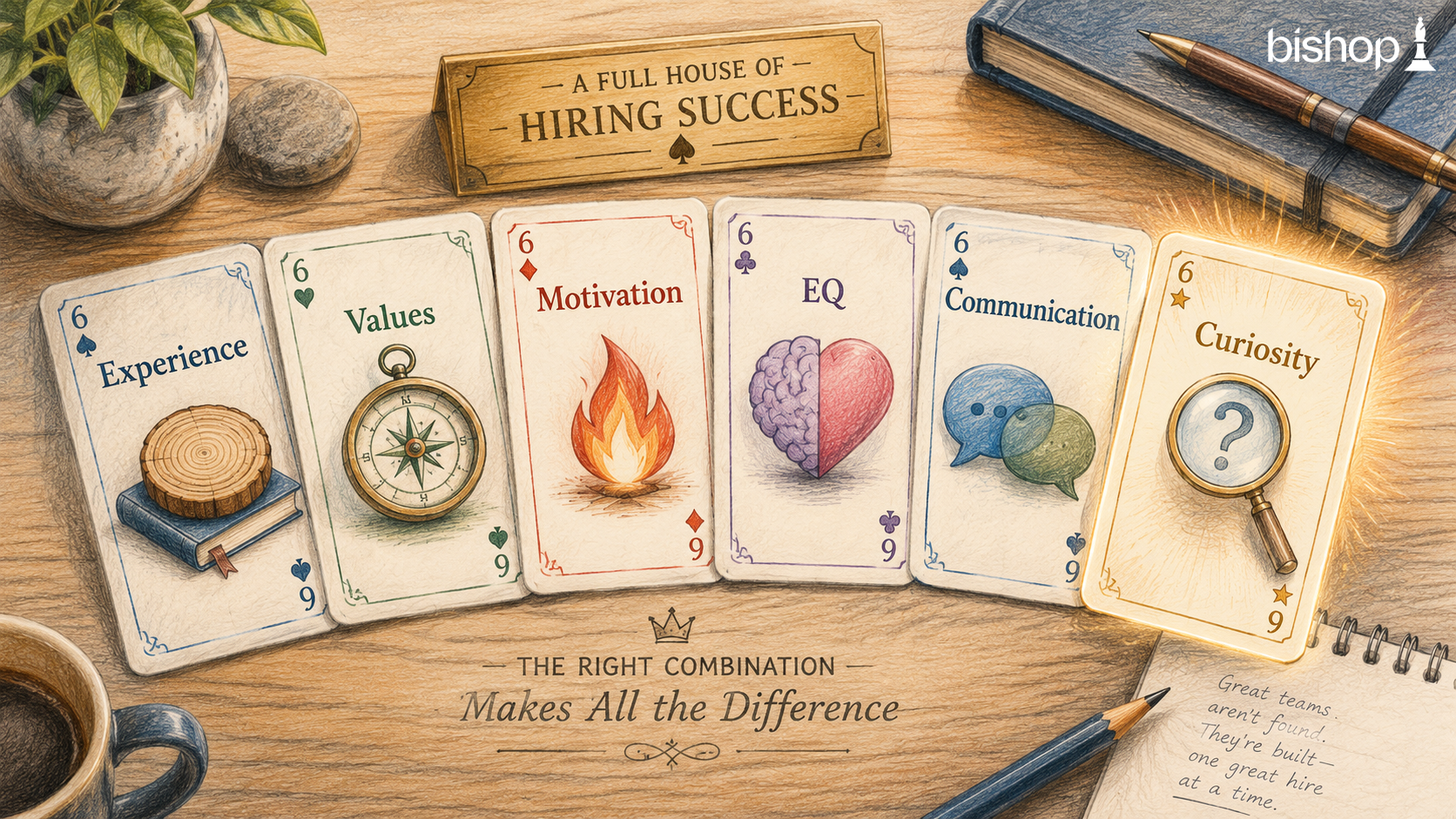
When talking with candidates and clients about employee success factors, I often return to familiar themes such as: motivational fit, values alignment, emotional intelligence, communication, shared purpose and the ability to contribute positively to a team.
All of these factors are important, commercially relevant and desirable characteristics we want to see displayed.
But there is another factor I probably haven’t always talked enough about.
Curiosity.
And I’m not talking about the nosy-neighbour-over-the-fence kind of curiosity, but rather the kind of openness that keeps people learning, listening, adapting and wondering. The kind that makes someone ask better questions, challenge their own assumptions, avoid confirmation bias, stay interested in other people and remain alert to what is changing around them.
In recruitment, curiosity is often one of the subtle differentiators between someone who relies on their tried and tested experience and someone who has the same experience but still questions how they use that experience. It might seem like a small distinction but the learning agility genuinely makes all the difference.
The age question
As I’ve aged, so too have many of my candidate and clients. Earlier in my recruitment career, I worked more often across entry-level and middle-management roles. These days, a greater proportion of my work sits in senior leadership, executive search and more complex appointments.
That means the average age of the candidates I meet has gone up. It also means I am asked a question more often than I used to be:
“Is my age going to count against me?”
The politically correct answer is “Of course not, age doesn’t matter”, but the honest answer is sometimes, “yes”.
We can dress that up if we want to, but it wouldn’t make it more useful. Age bias exists. Some hiring managers will make assumptions, consciously or unconsciously, about energy, adaptability, technology, salary expectations or whether someone might be “too set in their ways”.
Some of those assumptions are unfair. Some are lazy. Some are simply wrong. But there is another, deeper truth I have noticed over more than 25 years in recruitment, at times, age isn’t the real issue but rather it’s one of the adjacent issues that can come with age and time:
The fading of curiosity.
Curiosity doesn’t have to retire
When we are young in our careers, curiosity is almost unavoidable. We don’t know much yet, so we have to ask questions. We are watching, learning, copying, testing and trying to work out what on earth is going on. We are genuinely curious because we have to be to learn, grow and succeed.
Over time, things can shift. With the building of experience and gradually increasing confidence, patterns start to become familiar and, over a few repeating cycles, a few restructures, a few leadership fads, a few “transformational” strategies (that look suspiciously like the last transformational strategy with a new font!), cynicism grows, patterns feel predictable and, somewhere along the way, healthy wisdom can quietly harden into certainty of the inevitable.
A risk starts to appear, not because someone is older but because they have stopped being interested in the ‘now’ – they have stopped being curious.
And here is the important point: unlike my hairline, learning agility does not have to fade with age. It can be protected, practised and renewed.

Experience plus curiosity is gold
I’ve always quite liked the joke that knowledge is the awareness that a tomato is a fruit and wisdom is knowing not to put it in a fruit salad! The strongest senior candidates I meet are not the ones who simply have the longest CV’s. They are the ones who have accumulated knowledge and wisdom but without losing their wonder and curiosity.
They bring the judgement that only comes from experience. They have lived through difficult conversations, commercial pressure, complexity, conflict, change and the occasional board paper that could have been a three-line email.
They have developed emotional intelligence through thousands of interactions with different people. They can read a room. They know when to push, when to pause and when to let silence do some useful work.
But they also remain curious and interested in what is changing. They ask what they need to learn next and they want to understand how younger professionals think, what technology is reshaping, how expectations are shifting and why yesterday’s answer may not solve tomorrow’s problem.
That combination is powerful because experience without curiosity can become rigidity. Just as curiosity without experience can lead down a meandering maze filled with predictable failure points. And this is why experience paired with curiosity can be such a winning formula.
Why younger candidates often compete so strongly
I regularly meet smart, capable and curious younger professionals who bring real energy into a process. They may not have seen every scenario before but they are interested, adaptable and hungry to learn and that genuinely matters to smart hiring managers.
In fact many leaders will consciously choose less experience when it is matched with learning agility, strong motivation, values alignment and a curious mindset. Not because experience has stopped mattering but because experience is no longer enough to ensure success on its own.
In a world where technology, expectations, markets, work patterns and organisational cultures are all shifting quickly, the ability to keep learning is not a nice-to-have so much as an essential survival skill.
A candidate who says, “I don’t know, but I’d love to understand,” may be more valuable than one who says, “I’ve seen this all before and know what’s likely to happen.”
It’s amazing how often our confirmation bias means that they haven’t actually seen the same thing before – they just think they have. They may have seen something similar, and similar can be useful. But it is not the same. The world keeps changing, evolving and we may miss out on an opportunity if we forget to challenge our thinking.

Capability remains an important base layer
None of this means we ignore capability. Skills, experience and technical credibility still provide an important foundation toward getting the right people on the bus.
But capability alone does not guarantee contribution. That is a point I return to often in my own writing. Many hiring decisions don’t go wrong because the person lacked the technical ability to do the job. They go wrong because something deeper did not align: motivation, values, communication style, emotional intelligence, adaptability or the way the person showed up under pressure.
Curiosity sits right in that deeper layer.
It influences how someone listens and how they learn, how they respond to feedback, whether they seek understanding before they seek to be understood. It influences whether they build bridges across generations, functions and perspectives or whether they retreat into “this is the way I’ve always done it”.
Curiosity and emotional intelligence belong together
One of the reasons curiosity matters so much is that it is closely linked to emotional intelligence. A curious person is more likely to ask things like, “What am I missing”, “How might this land for someone else?”. They are more likely to notice, “Why is this person reacting this way?”
That doesn’t mean they become endlessly accommodating or indecisive. Curiosity is not weakness, it’s not sitting in a meeting stroking your chin while the building burns around you. Rather, it’s the discipline of seeking enough understanding to make a better decision.
Curious leaders tend to listen before they label and explore before they defend. They stay open to evidence and aren’t threatened by challenge. They are more interested in learning than being right. And that isn’t a sign of softness so much as strength. And just quietly it is also commercially savvy.
Curiosity is also a values signal
I always ask candidates what their own values are and, when I assess values alignment, I’m not on the hunt for them to recite a list of noble nouns. Integrity. Teamwork. Respect. Excellence. Collaboration. Don’t get me wrong – those are all great – lovely words, easy to say and very often laminated on the company headed paper!
What I’m really looking for is how those values might show up in day-to-day behaviours and curiosity is one of the behaviours that often reveals whether someone’s stated values are truly real and reflected in how they show up.
If someone claims to value collaboration, are they genuinely interested in other perspectives? If they claim to value learning, can they talk about something that made them change their mind? When they claim to value diversity, do they really seek out difference? If they claim to value innovation, when did they last explore and implement a new or unfamiliar idea?
Values live in our choices and actions and curiosity helps us see those choices more clearly.
What this means for older candidates
For experienced candidates worried about age, my advice is not to pretend you are younger. Please don’t because nobody needs a senior executive suddenly describing themselves as “frothing about the opportunity and really vibing with the disruptive energy in the room” (okay, I can feel my daughter rolling her eyes and I’m sure that’s not what young people actually say – but you get my point!).
The answer is not to hide your experience but to show that it is still alive and that you are still learning. Talk about what has changed in your field and how you are adapting, the questions you are asking now that you would not have asked ten years ago. Talk about how younger colleagues have influenced your thinking and how your mistakes still inform your thinking and keep teaching you.
Talk about your existing wisdom and enduring curiosity as a strength, not an apology.
The best candidates do not position themselves as ‘finished products’ bringing all the solutions but rather they present as people with deep foundations, an active growth edge and learning mindset.
That’s an attractive combination in a candidate – whatever their age.

What this means for hiring managers
For hiring managers, the challenge is to avoid crude age-based assumptions in either direction. Youth does not automatically equal energy just as age does not automatically equal wisdom.
Experience does not automatically equal judgement and curiosity does not automatically belong to the young.
The job of a good selection process is to look beneath the surface and to ask things like:
- What are you learning at the moment?
- What have you changed your mind about recently?
- How do you stay current in your profession?
- Tell me about a time someone more junior than you changed your perspective.
- What is a question you wish more leaders were asking?
- Where do you think your sector is heading in the future?
- What part of this role would stretch you?
- What skills are you still working on?
Listen carefully to the answers as the best candidates will usually lean in to these discussions and will think, engage and respond with enthusiasm. They may not have polished answers, but they will have energy.
Those who show up without a willingness to question assumptions will often default to broad statements, old war stories or a slightly weary “been there, done that” tone. Sometimes they have indeed been there and done that but then the question needs to be whether they are still interested in what comes next?
The full house
In hiring, we are often balancing trade-off’s, sometimes choosing potential over experience or values alignment over perfect technical fit. Sometimes we choose hunger, humility and curiosity because the person has enough credibility to learn and grow into the rest.
Every now and then, we find the full house and meet a person with experience, values alignment, motivational fit, emotional intelligence, great communication skills, a shared sense of purpose and genuine curiosity.
And it’s not as rare as you might think , but when that happens, pay attention, because these are the people who do more than perform a role. They lift the room, ask better questions, help others grow and bring wisdom without arrogance and openness without naivety.
These are the people who create positive ripples.
In a fast-changing world, that may be one of the most valuable forms of leadership there is. So, if you are a candidate wondering whether age will count against you, perhaps you should be asking yourself a better question:
Am I still curious?
The future won’t necessarily belong only to the young, the experienced or the technically brilliant but rather, it will likely belong to those who remain interested enough to keep growing.
Chins may increase, waistlines expand and hairlines retreat but aging doesn’t mean that curiosity has to leave us behind!
 About the Author
Rob Bishop is the Director of Bishop Associates, a Christchurch-based executive search and recruitment consultancy known for its values-driven, people-first approach. With over 25 years’ experience in recruitment, leadership assessment and governance advisory, Rob and his team work closely with boards and leaders on CEO & senior appointments, executive alignment, generalist recruitment and human resource needs; supporting long-term organisational success.