

Why getting to know each other might be the most under-rated governance strategy
In the boardroom, we often talk about value. Adding value. Protecting value. Creating value. But here’s something I’ve noticed more often lately:
Many boards are so focused on delivering value to the organisation that they forget to invest in something equally important…the quality of their relationships with each other.
They forget they’re a team. Not just a group of skilled individuals. Not just a collection of job titles or delegated roles. But rather a leadership team, with shared responsibility for the direction, oversight and long-term wellbeing of the organisation.
And like any team, their ability to govern well is directly shaped by the trust, understanding and cohesion between them.
The Cost of Staying Strangers
Even the most well-meaning directors can fall into a pattern of turning up, reading the papers, offering their insight… and leaving. Rinse and repeat. But in the absence of relational depth, boards risk:
- Missed opportunities to challenge or contribute with insight
- Siloed voices or repeating power dynamics
- Unclear expectations between board members and the CEO
- Fragmented oversight where the board feels disjointed or confusing
And in moments of tension or crisis, the cracks start to show.
In some settings, especially high-visibility or politically appointed boards, the risks can run even deeper. It’s not uncommon to see directors more focused on their personal brand than their collective responsibility. I’ve had more than one executive comment (perhaps only half-joking!) that they suspect the board papers were read in the car on the way to the meeting.
Communication outside of formal sessions can be minimal, and trust between members shallow.
It’s not just frustrating. It’s governance risk.
Because without real connection, challenge becomes performative, oversight becomes reactive and the CEO is left to interpret a swirl of individual voices rather than one clear board position.
Strategic Governance Needs Relational Trust
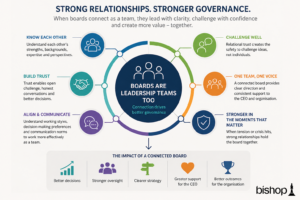
I’m not suggesting boards turn into constant team-building retreats. But I am suggesting that governance improves when the governors know each other well enough to lead as a collective, not just as individuals.
When you understand each other’s:
- Strengths and professional backgrounds
- Communication and decision-making styles
- Areas of interest or sector expertise
- Pressure points and blind spots
…you’re more likely to govern with unity, clarity and confidence.
You’re also better positioned to support your CEO, who otherwise may find themselves navigating a tangle of mixed messages or power dynamics rather than one clear, aligned board voice.
A Few Questions to Reflect On
If you’re a board chair, director, or CE, here are a few prompts that might be worth discussing at your next retreat or review:
- How well do we really know each other around this table?
- Have we ever mapped the strengths and experiences of our board team?
- Do we understand each other’s working styles, or just assume alignment?
- What does our CEO see when they look at us – a team, or a set of individuals?
- How do we onboard new board members into our culture, not just our compliance?
Boards Model the Culture They Want
If we expect the executive team to build trust, collaborate well, and lead with shared purpose – then the board should model that too, because like it or not, boards set the tone.
So here’s a simple suggestion:
Next time your board meets, don’t just ask what the organisation needs.
Talk about what you need – to show up well. Together.
Because boards are leadership teams too.
And the better they function together, the more value they can create. Not just oversee.
 About the Author
Rob Bishop is the Director of Bishop Associates, a Christchurch-based executive search and recruitment consultancy known for its values-driven, people-first approach. With over 25 years’ experience in recruitment, leadership assessment and governance advisory, Rob and his team work closely with boards and leaders to support CEO appointments, executive alignment and long-term organisational success.